Product Designer

Millet: The Future Grain of India
To deepen the understanding, we explored millets as a source of nutrition for Indians. Neglected, misunderstood, yet full of potential. A grain that connects soil, stomach, and sustainability using the approach of human centred design for systems.
COURSE
Human Centered Design for Systems, Services, Strategy and Speculation
TEAM
Rahul Raj Singh (Designer)
Parnavi Dinkar (Designer)
Tina Soni (Architect)
DURATION
16 Weeks
TOOLS


OBJECTIVE(S)
Systemic exploration of Indian bread ecosystem
Study cause and effect relationships
Change in perception and consumption divergences
Surface leverage points
OUTCOME(S)
Developed a gigamap and systhesis map
Behavioral Design: Perception Shift through experience
Featured on Swayam Prabha NPTEL lecture series
Published maps and exhibits in RSDX14, OCAD

Introduction
Millets are more than just a grain - they are nutrient-rich, climate-resilient, and deeply tied to India’s agricultural identity. Yet, despite their well-documented benefits, wheat and rice grains dominate the market, leaving millets underutilised and under-appreciated.Low awareness, limited product innovation, and an inefficient Public Distribution System further widen this gap.
Our synthesis map explores how climate, agriculture, and consumer behaviour intersect to shape grain consumption. By mapping emergent patterns, we uncover leverage point for awareness, and perception - laying the foundation for millet’s transformation from the "grain of the poor" to the "grain of the future."
Scope
• Systemic Mapping of Indian breads and millet-based food networks
• Identification of Barriers and Leverage Points across production, consumption, and perception
• Evaluation of Socio-Economic Factors influencing millet adoption in urban contexts
• Conceptualization and Prototyping of Interventions to promote awareness and accessibility
• Integration of Behavioural and Design Research to inform experiential and communication strategies
Timeline
16 weeks
Contributors
Rahul Raj Singh, Parnavi Dinkar, and Tina Soni


Framing the system
Cooking is a fundamental human activity, rich in regional variations, rituals, and resources. The story of how cooking habits evolve, sustain themselves, or fade over time and what that says about systems at large is itself a fascinating story.
How people cook across India, and more importantly, why they cook that way requires an exploration of geography, equipment, and fuel because cooking is never just about ingredients; it’s about access and adaptation. Food isn't just a product of culture, it's shaped by history, technology, and policy.
How cooking has evolved and how cooking practices changed across eras, from ancient and medieval techniques to colonial influences and post-industrial habits shapes our very understanding of ourselves as people – we are what we eat.


Comprehending the System
Gigamapping approaches can successfully aid in providing the canopy for nudging actors towards certain choices in systems. In this synthesis map we explore possibilities of sensitizing and nudging actors towards adoption or enhancing the use of millets as a food source.Millets stand at the intersection of sustainability and nutrition, offering a climate resilient alternative against the resource-intensive grains. As a climate-conscious crop, millets provide a drought and pest-resistant option that requires less water consequently making them a crucial component of future food systems.
We zeroed in on millets when we discovered the steep decline in consumption despite the plethora of health benefits. We mapped the emergent factors that directly and indirectly contribute to the decline in cultivation, distribution and consumption through a combination of stakeholder mapping, dimensions and classification.
After identifying the extremes in stakeholders, we moved on to study the different types of bread found in India. Our mapping exercise revealed nearly 63 distinct breads across the country, each unique in its own way.


Climate & Agriculture
To understand the current scenario, we started from the beginning; we not only looked at the traditional breads of India through the different eras but also added the dimension of climate, agriculture, digestion and pattern of consumption. This unveiled the relationship between climate and related agriculture and diets of the population in any given area. We also identified and understood how the various industries are supporting each other in order to survive the bread and grain business.


Green Revolution
The fall of millet in India didn’t happen overnight. It began with the revenge effects of the policies of the ‘Green Revolution’. While it was necessary at the time, it focused on wheat and rice to combat famine by introducing high-yielding varieties, investing in irrigation, and stabilising food security which made rice and wheat easier to grow. But in doing so, it pushed millets out of the frame.

ZIP Analysis
To identify our intervention points, we first zoomed into the integration, literacy, supply chain, products and digestion of millets in the system as . This helped us identify awareness as our major leverage point and development of experiential stores as an emergent solution.


We talked about cooking complexity, short shelf life, taste preferences, and even social perceptions. But the real weight of the problem lies deeper, in the system itself.
The decline of millet in India isn’t just a matter of changing taste. It’s a reflection of structural decisions, policy priorities, and market neglect.
Pain Points


How might we make millet products (Ready-to-Eat & Ready-to-Cook) more accessible and appealing to urban consumers by enhancing awareness and improving literacy?
The ZIP analysis revealed that while awareness and perception were key barriers, several leverage points emerged for systemic change encouraging millet inclusion in the Public Distribution System (PDS), fostering collaborations with Quick Service Restaurants (QSRs) to increase visibility, driving public awareness for the cultural and nutritional upliftment of millets, and advocating for a policy shift that strengthens support for local millet ecosystems.
Intervention Points

After conducting the ZIP analysis and plotting the value proposition matrix, what stood out most wasn’t a gap in affordability or supply, it was perception. Consumers weren’t avoiding millet because it was expensive or unavailable; they were avoiding it because they didn’t recognise it, didn’t know how to cook it, and didn’t see others eating it. That insight revealed perception as the key leverage point.
As a result, we focused on developing an experiential store and detailing its design to bridge this gap.
Leverage Point


Envisioning the Intervention
The Millet Store is conceived as an experiential intervention strategically located near cafeterias and grocery outlets to align with existing consumer behaviors. Positioned within malls, commercial complexes, or community hubs, it encourages organic engagement with millet-based offerings. Supported by curated touchpoints such as tastings, workshops, and digital platforms, the store fosters informed discovery. This integrated approach aims to drive long-term dietary shifts towards millet consumption.

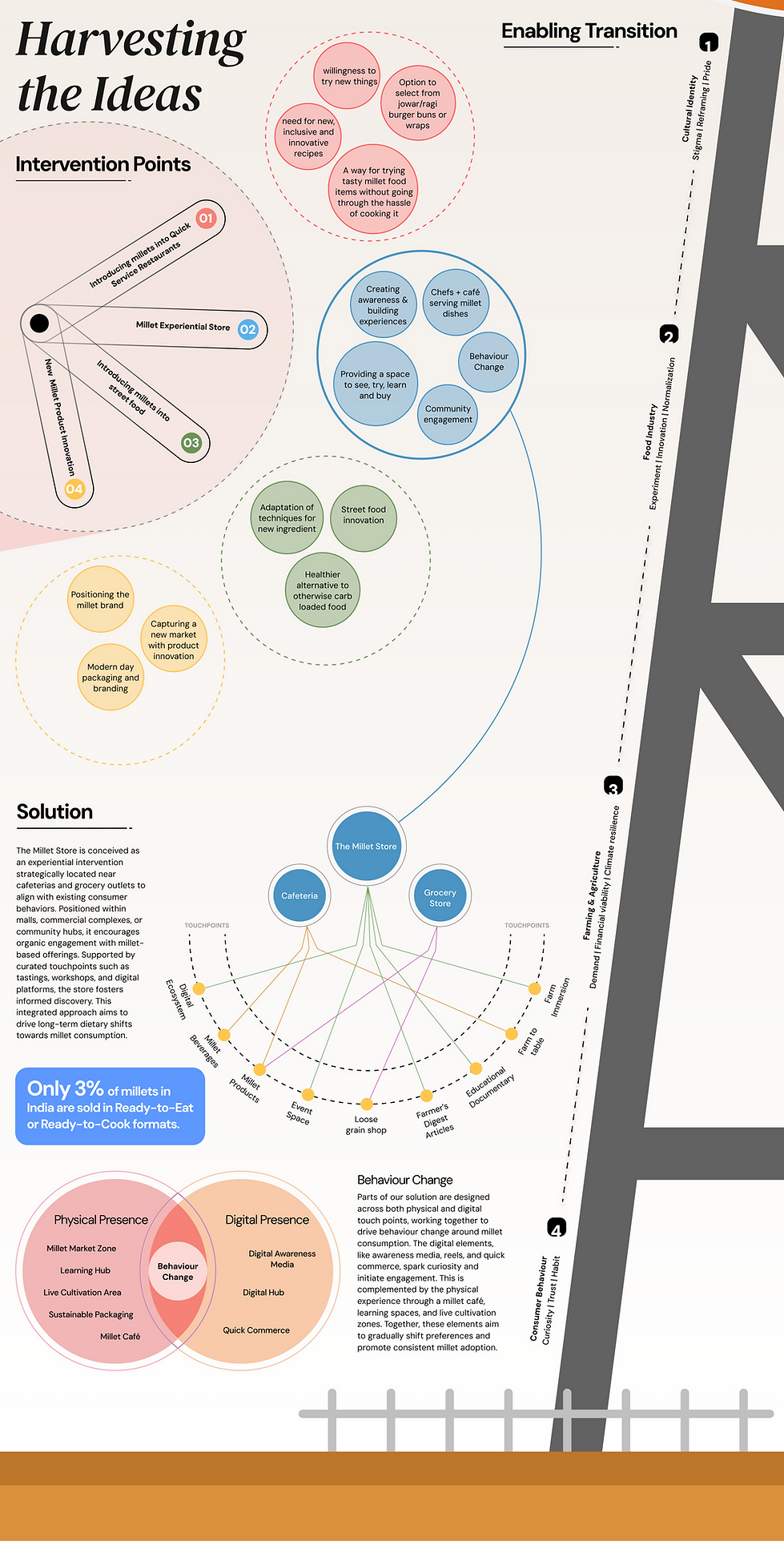
Formulating of the Intervention
The e-commerce experience, coupled with an experiential store, is designed to reduce hesitation around millets by embedding them into familiar food choices, clear nutritional comparisons, and low-risk trials. Together, the digital and physical touchpoints help users experience millets before committing supporting a gradual shift from curiosity to confidence, and from viewing millets as a niche “healthy option” to adopting them as a practical, everyday staple.
Explore the interactive prototype to see how the features work in context.


Millet-ify your food
Anchors millet adoption in existing food habits by mapping familiar dishes to functionally suitable millet substitutes, surfaced with high-level nutritional trade-offs and direct product availability.
9/15 participants stated they would be “willing to try this once” when substitution was dish-led rather than ingredient-led
Multiple participants described the flow as “less intimidating than browsing millets directly”
Problem it is tackling
Adoption breaks at the point of translation, users understand millets conceptually but struggle to apply them to everyday meals.
Switching staples is perceived as a high-effort behavioural change.
Comparative Nutritional View
A visual comparison between any selected millet and wheat across a consistent set of nutritional and Sensory dimensions.
12/15 participants could correctly identify one nutritional advantage after viewing the visual
10/15 participants preferred the visual comparison over text or tables
Problem it is tackling
Adoption breaks at the point of translation, users understand millets conceptually but struggle to apply them to everyday meals.
Switching staples is perceived as a high-effort behavioural change.
Try Millets (Guided FTU Trial)
A low-friction onboarding flow generating a personalised, small-quantity millet trial kit.
13/15 participants said they would prefer a trial pack over buying a full-size product
Trial framing reframed purchase as “experiment” rather than commitment
Problem it is tackling
High perceived risk for first-time buyers
Fear of wasting money on unfamiliar grains


Enabling the Transition
Our objective is to redirect consumers’ focus from wheat to millet rich diets, keeping in mind the geography, climate, demographics, and culture and bring a shift from the foreign grains to indigenous grains which are appropriate for people living in India. We also aim to promote millet as a climate conscious crop as it aligns with Sustainable Development Goal 13 - Climate Action. Redirecting and educating consumers about healthier alternatives also fulfils Sustainable Development Goal 03 - Good Health and Wellbeing. Lastly, bringing back millets into the diets ensures that there is no surplus that is getting unutilised, which targets Sustainable Development Goal 12 - Responsible Consumption and Production.
Behavioral change isn’t about enforcing, it’s about inviting. By sparking curiosity and building trust, change can grow as a movement, not a mandate. Millets are more than food; they represent sustainability, resilience, and choice, aligning with global goals for health, climate, and conscious living. Change isn’t always easy, some may resist the taste or effort, but transitions aren’t about perfection, they’re about possibility. With the right experience and exposure, even small shifts can lead to big change. The Millet Story is a signal, of what’s ahead, of eating with purpose, and reconnecting with what truly sustains us.
